


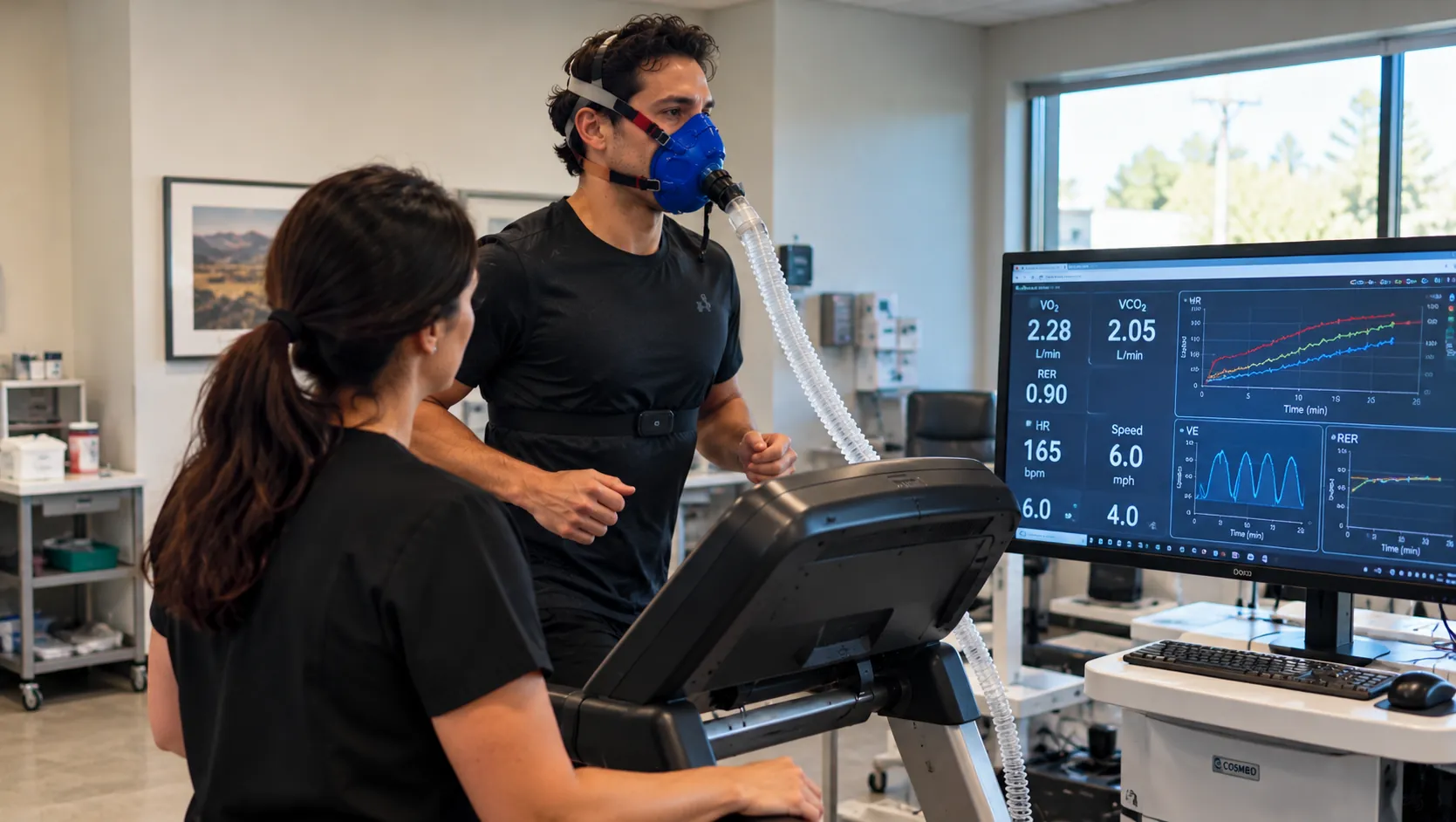
Metabolic Testing: What RMR and VO2 Max Each Actually Measure
Metabolic testing gets used as a single term for two tests that measure entirely different things. One tells you how many calories your body burns at rest. The other tells you how efficiently your heart, lungs, and muscles use oxygen when you push hard. Confusing them is the most common reason people book the wrong one.
Elevate Health Group provides metabolic and VO2 max testing at our Glendale, Burbank, and La Cañada offices. This page explains what each test measures, what the results change, and when either is genuinely worth doing.
RMR: What Your Body Burns at Rest
Resting metabolic rate is the energy your body uses simply staying alive, running your brain, heart, kidneys, and everything else while you sit still. For most people it accounts for the majority of daily calorie expenditure.
It is measured by indirect calorimetry. You rest quietly while a device analyses the oxygen you consume and the carbon dioxide you produce, usually for ten to twenty minutes. From that gas exchange, your actual resting burn is calculated.
The reason this matters is that the alternative is an estimate. Standard equations such as Mifflin-St Jeor predict RMR from height, weight, age, and sex, and they are reasonable across a population while being capable of missing an individual by a meaningful margin in either direction. If your nutrition plan is built on an estimate that is wrong for you, the plan inherits the error.
VO2 Max: How Well You Use Oxygen Under Load
VO2 max is the maximum rate at which your body can take in and use oxygen during intense exercise, expressed in millilitres per kilogram per minute. It is measured during a graded exercise test, typically on a treadmill or bike, with intensity increasing until you reach your limit.
It is the standard measure of cardiorespiratory fitness, and it is one of the better-studied markers in preventive medicine. A large study of roughly 122,000 patients undergoing exercise treadmill testing, published in JAMA Network Open in 2018, found cardiorespiratory fitness inversely associated with long-term mortality, with no observed upper limit to the benefit.
That is a stronger evidence base than most wellness metrics carry, which is why VO2 max has moved from sports science into general preventive care.
The Difference in One Table
| RMR | VO2 max | |
|---|---|---|
| What it measures | Calories burned at rest | Maximum oxygen uptake under exertion |
| How it is done | Quiet breathing through a mask at rest | Graded exercise test to maximum effort |
| Roughly how long | 10 to 20 minutes | 15 to 30 minutes including warm-up |
| Effort required | None | Maximal |
| Mainly used for | Nutrition and weight planning | Fitness assessment and training zones |
| Changes with training | Modestly | Substantially |
They answer different questions. Neither substitutes for the other, and plenty of people only need one.
How Results Actually Change a Plan
This is the part worth being concrete about, because a number that changes nothing is not worth paying for.
An RMR result replaces an estimate with a measurement in your calorie target. If your measured RMR comes in materially below the equation-based prediction, a plan built on the prediction would have had you eating more than intended. For patients in our medical weight loss programme, it also gives a baseline to re-measure against later, since RMR can shift as body composition changes.
A VO2 max result gives you training zones based on your own physiology rather than a formula based on your age. It also provides a baseline, so re-testing after several months of structured training shows whether what you are doing is working. Both pair naturally with body composition assessment, because weight alone cannot tell you whether a change came from fat or muscle.
Who Each Test Suits
Consider RMR if you are starting or stuck in a weight management plan, if your results have not matched the calorie target you were given, or if you have a condition such as thyroid disease that affects metabolic rate.
Consider VO2 max if you train seriously and want zones based on measurement, if you are building a long-term fitness baseline, or if you want an objective marker of cardiorespiratory health to track over years. Our longevity services use it that way.
Consider neither if you are not going to act on the result. These tests inform decisions; they do not make them.
What to Expect on the Day
For RMR, arrive fasted for several hours, avoid caffeine and exercise beforehand, and expect to rest quietly while the device records your breathing.
For VO2 max, wear training clothing, avoid a hard session the day before, and expect to work to genuine maximum effort for the final few minutes. Because the test involves maximal exertion, your physician reviews your cardiac history first, and the test is supervised throughout.
Results are reviewed with your physician rather than emailed as a number without context, and they are read alongside your labs from our on-site laboratory where relevant. Individual results vary.
Service Area
Testing is available at our Glendale, Burbank, and La Cañada offices, serving Pasadena, Toluca Lake, and greater Los Angeles County. Care is available in Armenian, Persian, Russian, and Spanish as well as English.
Frequently Asked Questions
Need Help? Find Answers Here
If you are not sure which test answers your question, that is worth a short conversation before booking either. Elevate Health Group sees adult patients in Glendale, Burbank, and La Cañada. Call 818-246-8000 or contact our office to discuss which is appropriate.
Source: Mandsager K, et al. Association of Cardiorespiratory Fitness With Long-term Mortality Among Adults Undergoing Exercise Treadmill Testing. JAMA Network Open, 2018.
YOU MIGHT ALSO ENJOY...

Peptides and Weight Loss: Approved, Not Approved, and Why It Matters
Some peptides are FDA approved for weight management and most marketed ones are not. How to tell which is which before you are prescribed anything.

Hangover IV Therapy: What It Treats and What It Does Not
IV fluids treat dehydration, not a hangover. What a drip actually does, what it costs, and when symptoms need a doctor rather than a drip.
Our Locations:
214 N Central Ave, Glendale, CA 912031407 Foothill Blvd, La Canada, CA 910113808 W. Riverside Dr, Ste 120, Burbank, CA 91505Hours of Operation:
Mon - Fri: 8:00 AM to 12:00 PM, 1:00 PM to 5:00 PM
Sat - Sun: Closed
© 2026 Elevate Health Group. All rights reserved.
 Designed & Developed by The Gud Agency