Mobile IV vs Clinic IV in LA: Comparing Convenience, Cost & Results
Time is your scarcest resource. Between back-to-back meetings, client deadlines, and the commute that swallowed your evening, spending an hour at a clinic for IV hydration feels impossible. That's where mobile IV therapy promises a solution: a nurse arrives at your home or office, you get your drip while answering emails, and you're done. No drive, no waiting room, no lost productivity.
But convenience isn't the only factor. Safety protocols, physician oversight, emergency capability, and cost all shift dramatically between mobile services and clinic-based care. For busy professionals in Los Angeles, the choice between mobile IV therapy and in-clinic treatment isn't just about scheduling it's about understanding trade-offs most services won't discuss upfront. This guide compares both options honestly. Our IV therapy service at Elevate Health Group offers both models at our Glendale, Burbank, and La Cañada clinics, plus physician-coordinated at-home visits.
What Mobile IV Therapy Actually Means
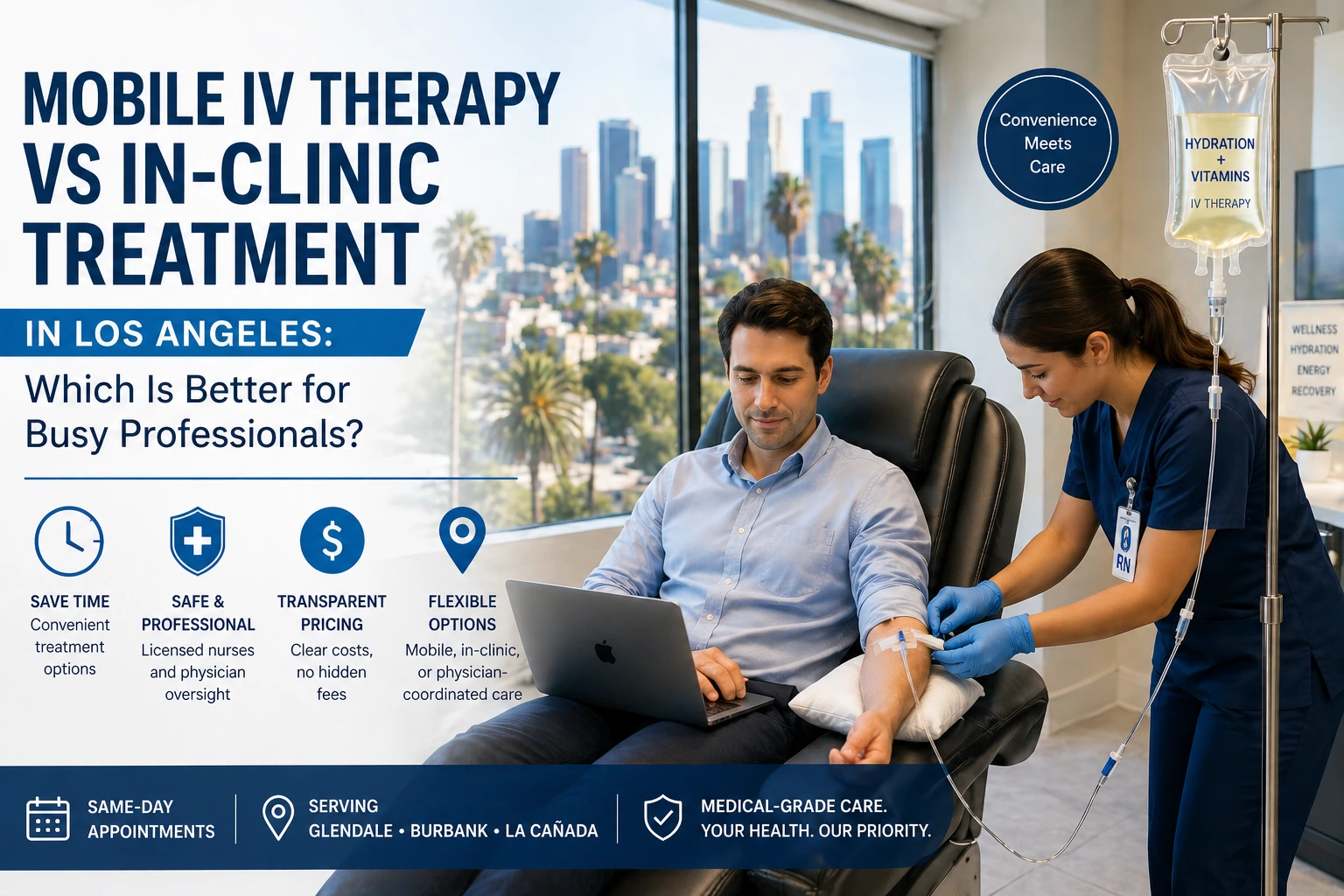
Mobile IV therapy sends a nurse typically an RN or LPN to your location with pre-mixed IV bags and basic supplies. You book online or via app, select your formulation hydration, vitamin boost, hangover relief, and a provider arrives within a scheduled window. The nurse inserts the IV, monitors the drip for 30–60 minutes, removes the catheter, and leaves.
What mobile services typically include:
- Standard IV formulations saline, electrolytes, B vitamins, Vitamin C
- Basic vital sign monitoring
- Single-use sterile supplies
- Treatment at your chosen location home, office, hotel
What mobile services typically don't include:
- On-site physician supervision
- Medical screening beyond a brief intake form
- Diagnostic capability labs, imaging, advanced assessment
- Emergency equipment beyond basic first aid
- Ability to adjust formulation mid-treatment based on response
Mobile IV therapy optimizes for speed and convenience. For mild dehydration, routine wellness, or post-travel recovery in otherwise healthy adults, this model works. For anything more complex, the limitations become constraints.
What In-Clinic IV Therapy Provides
Clinic-based IV therapy happens in a medical facility where licensed healthcare professionals RNs, PAs, or physicians administer treatment under direct medical supervision. At Elevate Health Group, every patient sees a provider before treatment begins, regardless of how routine the request seems.
What clinic-based care includes:
- Medical intake screening by licensed provider
- Real-time physician oversight
- On-site diagnostic capability our on-site laboratory tests electrolytes, kidney function, hydration markers
- Emergency protocols and equipment epinephrine, oxygen, crash cart access
- Ability to adjust formulation based on lab results or patient response
- Sterile clinical environment designed for medical procedures
Additional benefits at medical clinics:
- Same-day urgent care integration our urgent care service can evaluate severe symptoms
- Coordination with your ongoing care our preventive medicine team tracks patterns
- Insurance billing capability for medically necessary treatments
Clinic-based care prioritizes safety and medical rigor over convenience. The trade-off is simple: you spend 15 minutes driving instead of 0, and you sit in a treatment room instead of your living room.
The Convenience Factor: How Much Time Do You Actually Save?
Mobile IV therapy markets itself on time savings. Let's calculate whether that holds up.
Mobile IV timeline:
- Booking: 5 minutes
- Wait for arrival: 60–180 minutes scheduled window
- Treatment: 45–60 minutes
- Total: 110–245 minutes, location-locked the entire time
In-clinic IV timeline:
- Booking: 5 minutes
- Drive + check-in: 15–30 minutes
- Treatment: 30–60 minutes
- Drive home: 10–20 minutes
- Total: 60–115 minutes, compressed into one block
The hidden mobile cost: If the nurse arrives at the end of a 3-hour window, you've held your schedule hostage for 180 minutes to save 30 minutes of driving.
When mobile saves time: You're home sick and can't drive, at a hotel unfamiliar with LA, or have zero schedule flexibility.
When clinic is faster: Same-day walk-ins at our three locations, controlled start times, already in the area.
For professionals who value predictability, clinic-based care wins.
Safety Differences That Matter
This is where the gap between mobile and clinic-based care becomes critical.
Emergency response capability:
Mobile services operate with minimal emergency equipment. If you have a severe allergic reaction, anaphylaxis, or cardiovascular event during treatment, the nurse's options are limited to calling 911 and providing basic first aid while waiting for paramedics. Response time in LA can be 8–15 minutes or longer.
In-clinic settings have crash carts, defibrillators, oxygen, epinephrine, and physicians trained in emergency medicine on-site. Response is immediate. For high-dose treatments, immune-compromised patients, or anyone with cardiac or kidney conditions, this capability gap is non-negotiable.
Medical screening depth:
Mobile providers typically use brief intake forms and verbal confirmation. They're assessing whether treatment is obviously contraindicated, not whether it's medically optimal. Most can't run labs, so they don't know your kidney function, electrolyte levels, or hydration markers before starting an IV.
Clinic-based providers perform comprehensive medical screening. Our board-certified physicians review your full medical history, current medications, and can run real-time labs to guide formulation decisions. If you have underlying kidney disease and don't know it, we'll catch that before it becomes a problem.
Sterile environment standards:
Mobile providers bring sterile supplies, but they're setting up IV equipment in your living room, office, or hotel room environments not designed for medical procedures. Contamination risk is low with proper technique, but it's higher than a purpose-built clinical setting.
Clinics maintain medical-grade sterile protocols. Surfaces are sanitized between patients, air filtration meets healthcare standards, and the entire environment is designed to minimize infection risk.
Who should choose clinic-based for safety:
- Anyone with chronic health conditions diabetes, kidney disease, heart failure, autoimmune disorders
- Patients taking medications that affect kidney function or fluid balance
- Anyone receiving high-dose IV formulations 50g+ Vitamin C, glutathione, chelation therapy
- People with a history of allergic reactions or adverse drug events
- First-time IV therapy patients
Who can reasonably use mobile for safety:
- Healthy adults with no chronic conditions
- Standard hydration or low-dose vitamin formulations
- Patients who've had the same treatment before with no issues
Safety isn't about fear-mongering. It's about matching risk to capability. Mobile services can't handle complications. Clinics can.
Cost Comparison: What You're Actually Paying For
| Service Type | Typical Cost LA | What's Included |
|---|---|---|
| Mobile IV basic hydration | $200 – $300 | Travel fee, standard saline/electrolytes, nurse time |
| Mobile IV enhanced formulation | $300 – $500 | Travel fee, vitamins/antioxidants, nurse time |
| Clinic IV basic hydration | $100 – $200 | Medical screening, saline/electrolytes, physician oversight |
| Clinic IV enhanced formulation | $150 – $350 | Medical screening, vitamins/antioxidants, physician oversight, lab capability |
Mobile services charge a premium typically $100–$150 more than clinic-based care for the convenience of coming to you. You're paying for the nurse's travel time, vehicle costs, and the operational complexity of mobile logistics.
Cost drivers for mobile:
- Travel fees often $75–$150, sometimes bundled into base price
- Service area premiums West LA, Beverly Hills, Malibu cost more
- After-hours or same-day surcharges
- Inability to negotiate package pricing
Cost advantages for clinics:
- No travel fees
- Package pricing for multiple sessions 15–30% savings
- Insurance billing for medically necessary treatments rare, but possible for dehydration from diagnosed illness
- HSA/FSA accepted both models qualify, but clinics handle documentation better
At Elevate Health Group, we offer transparent pricing with no hidden fees. Contact us for current rates and package options. Our physician-coordinated at-home visits cost more than in-clinic but less than most mobile-only services, because you're getting medical-grade care without the wellness-spa markup.
The Hybrid Option: Physician-Coordinated Mobile Care
Not all mobile IV therapy operates the same way. Standard mobile services send a nurse with minimal physician oversight. Physician-coordinated mobile care what we offer through our at-home visits program operates differently.
How physician-coordinated mobile works:
- Your case is reviewed by one of our licensed physicians before the visit
- Medical screening happens via telehealth or detailed intake
- The nurse who arrives carries physician-approved formulations specific to your case
- Real-time physician contact during treatment if complications arise
- Integration with your ongoing care we can coordinate with your primary care or preventive medicine plan
This model bridges the gap: you get clinic-level medical oversight with mobile convenience. Cost sits between standard mobile and in-clinic, but safety approaches clinic standards.
Best used for:
- Patients with chronic conditions who genuinely can't travel
- Post-surgical recovery where mobility is limited
- High-dose or complex formulations requiring physician oversight
- Ongoing treatment series where convenience and safety both matter
Standard mobile services can't replicate this model because they don't have physician infrastructure. Wellness spas offering IV therapy lack the medical framework. Physician-coordinated mobile requires a full medical practice behind it.
Which Option Fits Your Situation?
Choose mobile IV therapy if:
- You're healthy with no chronic medical conditions
- You're receiving basic hydration or standard vitamin formulations
- You've had the same treatment before with no issues
- Your schedule genuinely has zero flexibility for a clinic visit
- You're willing to pay a premium for location convenience
Choose in-clinic IV therapy if:
- You have any chronic health conditions
- You're receiving high-dose or complex formulations
- This is your first IV therapy experience
- You value medical screening, diagnostic capability, and emergency protocols
- You want the best cost-to-value ratio
- You care about insurance billing or HSA/FSA documentation
Choose physician-coordinated mobile if:
- You have medical complexity but can't travel to a clinic
- You're receiving ongoing treatment and want continuity of care
- You need mobile convenience but won't compromise on safety
- You want treatment integrated with your broader health plan
For most busy professionals in Los Angeles, in-clinic care delivers better safety, better value, and comparable convenience once you account for mobile scheduling windows. The 30 minutes you spend driving to our Glendale clinic buys you physician oversight, emergency capability, real-time labs, and peace of mind that mobile services can't match.
Conclusion
Mobile IV therapy offers undeniable convenience: treatment comes to you, no driving required. But convenience alone doesn't determine the right choice. Safety protocols, medical oversight, emergency capability, cost, and your personal health complexity all matter.
For healthy adults seeking routine hydration or wellness IV therapy, mobile services work fine. For anyone with chronic conditions, receiving high-dose treatments, or prioritizing safety and medical rigor, clinic-based care is the smarter choice. And for those who need both medical-grade safety with mobile flexibility physician-coordinated at-home care exists, though few providers offer it.
At Elevate Health Group, we provide all three models because we recognize different patients have different needs. Our IV therapy service operates from three LA-area clinics with same-day walk-in availability, and our physician-coordinated at-home visits bring medical-grade care to your location when you genuinely can't come to us.
Book your IV therapy session or learn more about our approach. For questions about which model fits your situation, contact us anytime.
Frequently Asked Questions
Is mobile IV therapy safe for healthy adults without medical conditions?
Yes, for healthy adults with no chronic conditions, mobile IV therapy is generally safe when administered by licensed nurses using sterile technique. Risks are low for basic hydration and standard vitamin formulations. However, mobile services lack on-site emergency capability, so any adverse reaction requires waiting for paramedics. If you have any health concerns, even minor ones, clinic-based care is safer.
How much more does mobile IV therapy cost compared to in-clinic treatment in Los Angeles?
Mobile IV therapy typically costs $100–$200 more than in-clinic treatment due to travel fees and operational complexity. Basic mobile hydration runs $200–$300 vs $100–$200 in-clinic. Enhanced formulations cost $300–$500 mobile vs $150–$350 in-clinic. You're paying for convenience, not better care. Clinic-based treatment offers better value, especially with package pricing.
Can I use my HSA or FSA for mobile IV therapy, or does it only work for clinic visits?
Both mobile and in-clinic IV therapy can qualify for HSA/FSA reimbursement, as both are medical services. However, clinics typically handle documentation better, making reimbursement easier. Elective wellness IV therapy is rarely covered by insurance, but if dehydration stems from a diagnosed medical condition, the consultation may be covered. Contact us for guidance on your specific situation.
What happens if I have an allergic reaction during mobile IV therapy at home?
If you experience a severe allergic reaction during mobile IV therapy, the nurse will call 911 and provide basic first aid while waiting for paramedics. Mobile providers carry minimal emergency equipment, no crash carts, defibrillators, or advanced medications. In-clinic settings have full emergency capability with physicians on-site. This is why clinic-based care is recommended for anyone with a history of allergic reactions or receiving high-dose formulations.