


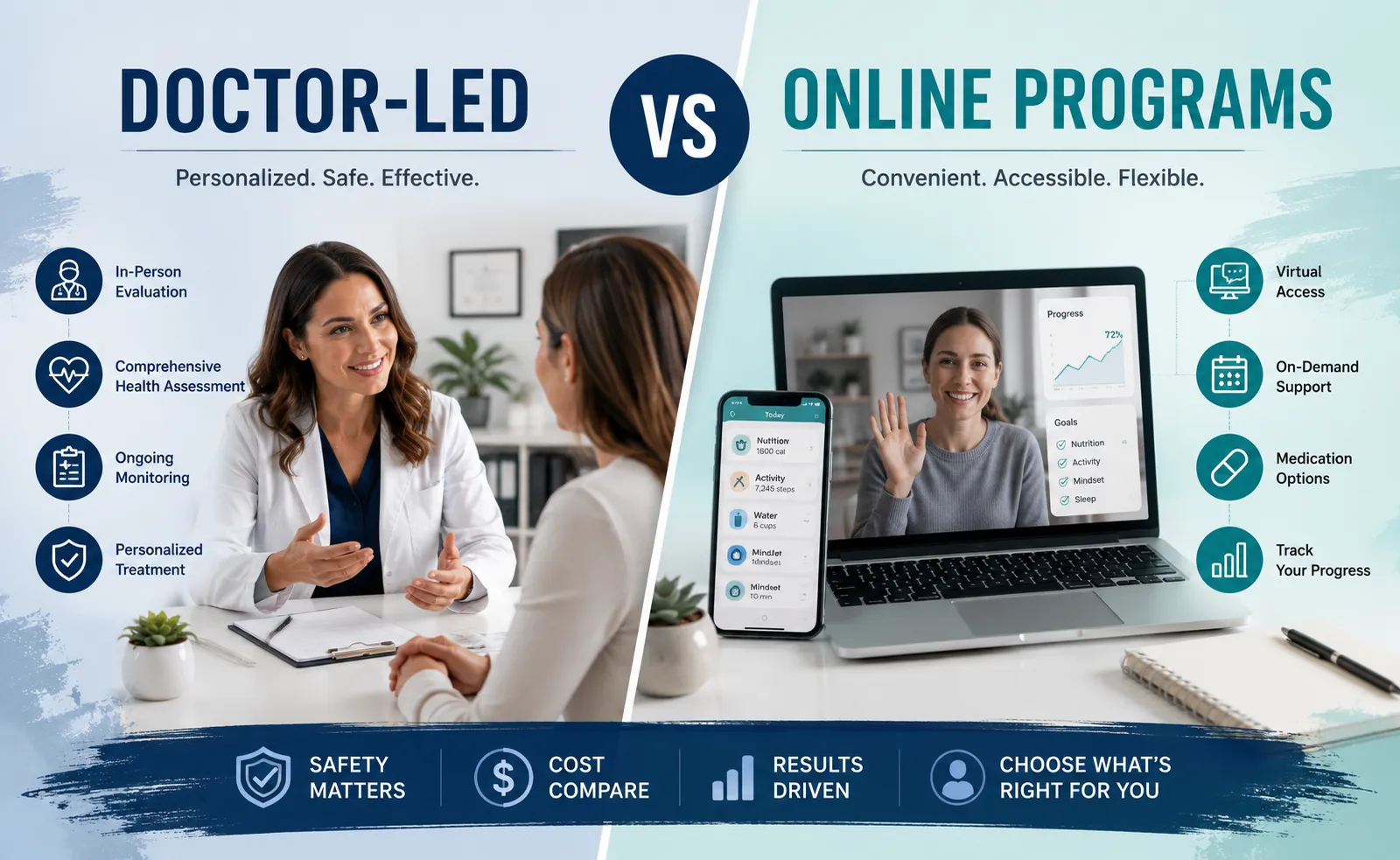
Doctor-Led Weight Loss vs Online Programs: Safety, Cost & Results Compared

Online weight loss programs promise convenience: apps, coaching, prescription medications delivered to your door — all without office visits. You're tempted by $49/month subscriptions vs $200+ in-office visits. But you've also seen concerning stories about online platforms prescribing powerful medications after 5-minute video calls with providers you'll never see again.
Doctor-led medical weight loss and online programs serve different needs, carry different risks, and deliver different results. This guide compares both approaches across safety, effectiveness, cost, and appropriate use cases. Our physician-supervised weight management at Elevate Health Group provides comprehensive in-person care at our Glendale, Burbank, and La Cañada locations.
Defining the Models
Doctor-led medical weight loss:
Physician-supervised programs at medical practices. Includes:
- In-person medical evaluation and ongoing monitoring
- Prescription medications when appropriate
- Laboratory testing and health screening
- Physical examination
- Comprehensive care coordination
- Direct physician oversight
Online weight loss programs:
App-based or telehealth services. Three main types:
1. Behavioral/coaching programs (Noom, WW, MyFitnessPal Premium):
- No physician involvement
- Behavioral coaching, food tracking, educational content
- No prescription medications
2. Telehealth prescription services (Ro, Henry Meds, Hims, Sesame):
- Brief video or questionnaire-based medical evaluation
- Prescription weight loss medications (usually GLP-1s)
- Minimal ongoing physician monitoring
- Medications shipped to you
3. Hybrid models (Found, Calibrate, Sequence):
- Telehealth physician consultations
- Prescription medications
- Health coaching component
- Some ongoing monitoring
Safety Comparison
| Factor | Doctor-Led (In-Person) | Online Programs |
|---|---|---|
| Initial evaluation | Comprehensive physical exam, medical history, lab work | Questionnaire or brief video call |
| Medication screening | Thorough contraindication screening, drug interaction review | Self-reported medical history (accuracy varies) |
| Ongoing monitoring | Regular in-person visits, physical exams, lab monitoring | Varies widely; some have none |
| Side effect management | Immediate physician access, dose adjustments, supportive care | Variable; some offer 24/7 support, others minimal |
| Emergency response | Established physician relationship, can be seen urgently | May need ER for acute issues |
Safety concerns with online programs:
- Inadequate screening: 5-10 minute video consultations miss contraindications that thorough exams catch.
- Self-reported accuracy: Patients may not know or disclose relevant medical history.
- Medication misuse: Some platforms prescribe powerful medications (GLP-1s) to patients who don't meet FDA criteria.
- Lack of monitoring: Side effects go undetected until they become serious.
- No continuity: Seeing different providers each visit prevents comprehensive care.
Real-world example:
Patient uses online platform, receives tirzepatide prescription after 8-minute video call. Develops severe abdominal pain (pancreatitis warning sign) 3 weeks later. Calls platform, told to go to ER. No established physician relationship to call. ER visit costs $3,500; condition caught early by in-person doctor would have meant stopping medication and monitoring — no hospitalization needed.
Our board-certified physicians perform thorough screening and provide ongoing safety monitoring.
Effectiveness Comparison
Doctor-led medical weight loss results:
Research shows physician-supervised programs with medications produce:
- 10-20% body weight reduction over 12 months (GLP-1 medications)
- Better adherence (in-person accountability)
- More comprehensive approach (medical + behavioral + nutritional)
- Long-term sustainability focus (transition planning, maintenance strategies)
Online program results:
Behavioral-only programs (Noom, WW):
- 5-10% body weight reduction over 12 months
- High dropout rates (60-80% quit within 6 months)
- Works well for motivated individuals with moderate weight loss goals
Telehealth medication programs:
- Comparable weight loss to in-person programs IF patient has no complications
- Lower adherence (easier to discontinue without face-to-face accountability)
- Higher dropout when side effects occur (less support)
The accountability factor:
In-person visits create stronger commitment. Scheduled weigh-ins, physician check-ins, and the effort of showing up increase adherence. Online programs rely entirely on self-motivation.
Cost Comparison
| Program Type | Monthly Cost | Medication Included? |
|---|---|---|
| Behavioral apps (Noom, WW) | $20-$70/month | No medications |
| Telehealth prescription platforms | $100-$500/month | Medications included (usually) |
| Hybrid telehealth programs | $200-$400/month | Medications included, plus coaching |
| Doctor-led in-person (insurance) | $75-$225/month | Medication depends on insurance coverage |
| Doctor-led in-person (cash-pay) | $350-$600/month | May include medications |
Insurance coverage:
- Doctor-led: Often covered (office visits, labs, sometimes medications with prior authorization). Copays apply.
- Online programs: Rarely covered by insurance. Some platforms don't work with insurance at all.
Cost-effectiveness depends on your situation:
- If insurance covers medications: Doctor-led is most cost-effective ($75-$225/month vs $200-$500 for online).
- If insurance doesn't cover medications: Online platforms bundling medication can be cheaper than retail pharmacy prices.
- For behavioral-only needs: Apps like Noom ($20-$70/month) are most affordable.
When Online Programs Make Sense
You're a good candidate for online weight loss programs if:
- Simple case: Healthy adult, no chronic conditions, BMI 30-35, no contraindications to medications.
- Motivated and disciplined: You stick to plans without external accountability.
- Medication-only approach works: You don't need intensive medical monitoring or complex care coordination.
- Access barriers: You live far from medical practices, have schedule constraints that prevent regular office visits.
- Cost-conscious with no insurance: Bundled online programs may be cheaper than separate doctor visits + retail medications.
Examples where online works:
- Healthy 35-year-old, BMI 31, no medical conditions, wants GLP-1 medication
- Busy professional with no time for office visits, good self-discipline
- Someone using Noom purely for behavioral tracking and coaching (no medications needed)
When Doctor-Led Programs Are Essential
You need in-person medical supervision if:
- Complex medical history: Multiple chronic conditions (diabetes, heart disease, kidney disease), complicated medication regimens, previous adverse reactions.
- High-risk situations: BMI >40, history of eating disorders, mental health concerns, previous unsuccessful medication trials.
- Medications requiring close monitoring: GLP-1s with diabetes, medications with potential drug interactions, conditions that contraindicate standard weight loss medications.
- Preference for comprehensive care: You want thorough monitoring, physical exams, and a physician who knows you.
- Insurance coverage: If your insurance covers in-person medical care, it's the better value.
Examples where in-person is necessary:
- 55-year-old with diabetes, hypertension, high cholesterol, starting tirzepatide
- Patient with history of gallstones or pancreatitis (higher risk with GLP-1s)
- Someone who needs care coordination between cardiologist, endocrinologist, and primary care
- Anyone experiencing significant side effects requiring dose adjustments or alternative approaches
Our comprehensive weight management serves complex cases requiring close medical supervision.
Quality Indicators for Online Programs
If you're considering online weight loss programs, look for:
- Licensed physicians practicing in your state: Verify credentials on state medical board websites.
- Thorough initial evaluation: Beyond 5-minute questionnaires. Video consultations should be 20-30 minutes minimum.
- Ongoing monitoring: Regular follow-ups, not just "message us if problems arise."
- Lab work requirements: Legitimate programs require baseline labs before prescribing medications.
- Transparent costs: All-in pricing disclosed upfront, no hidden fees.
- Clear physician access: You know who your doctor is and how to reach them.
- Appropriate patient selection: Programs that turn down patients who need in-person care (not just prescribe to everyone).
Red flags to avoid:
- "Get Ozempic in 24 hours with no appointment"
- No physician listed or credentials unclear
- Prescribing without any labs or medical history
- Marketing focused on rapid results, not safety
- No clear refund policy or patient protections
Hybrid Approach: Best of Both Worlds
Some patients benefit from combining approaches:
- Initial evaluation in-person: Comprehensive screening, baseline labs, physical exam, medication initiation with doctor.
- Ongoing support via telehealth: Monthly check-ins via video, dose adjustments, prescription refills.
- Periodic in-person visits: Every 3-6 months for labs, physical exam, progress assessment.
This maximizes convenience while maintaining safety and quality. Some medical practices now offer this hybrid model.
Conclusion
Doctor-led medical weight loss and online programs both have legitimate roles. Doctor-led care provides comprehensive evaluation, close monitoring, and personalized treatment — essential for complex cases and higher-risk patients. Online programs offer convenience and lower costs for straightforward cases in motivated individuals.
The right choice depends on your medical complexity, risk factors, insurance coverage, and personal preferences. If you have chronic conditions, take multiple medications, or need close supervision, choose in-person care. If you're healthy with simple weight loss needs and strong self-discipline, reputable online programs can work.
At Elevate Health Group, our physician-supervised weight management provides comprehensive care for complex cases while also offering telehealth options for established patients. Our board-certified physicians are available at our Glendale, Burbank, and La Cañada locations.
Schedule a weight loss consultation to discuss the best approach for your situation.
Frequently Asked Questions
Need Help? Find Answers Here
Related Posts

Tirzepatide Weight Loss Injections in Los Angeles: Cost, Results & Where to Get Treatment
Complete guide to tirzepatide (Mounjaro/Zepbound) weight loss in LA: how it works, costs, insurance coverage, and where to get treatment.
Medical Weight Loss Clinics That Accept Insurance in LA County: Coverage Guide
Find medical weight loss clinics in LA that accept insurance. Understand what's covered, prior authorization requirements, and how to maximize benefits.
Our Locations:
214 N Central Ave, Glendale, CA 912031407 Foothill Blvd, La Canada, CA 910113808 W. Riverside Dr, Ste 120, Burbank, CA 91505Hours of Operation:
Mon - Fri: 8:00 AM to 12:00 PM, 1:00 PM to 5:00 PM
Sat - Sun: Closed
© 2026 Elevate Health Group. All rights reserved.
 Designed & Developed by The Gud Agency