


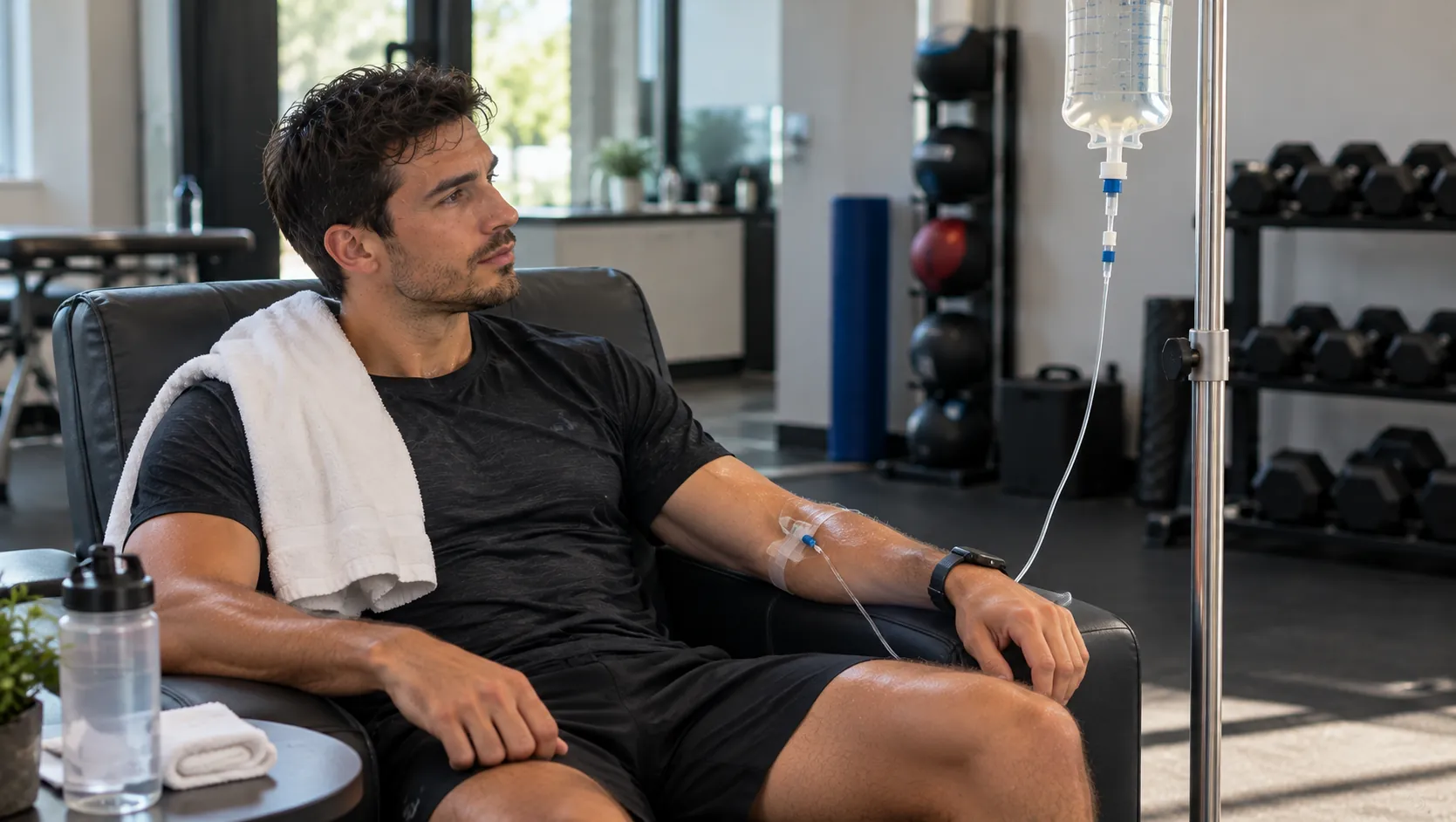
IV Drips for Athletic Recovery: What They Contain and the WADA Limit
Recovery drips have become a fixture in endurance and team sport circles, usually sold on the promise of faster rehydration and reduced soreness after hard training. Before the question of whether they work, there is a prior question that very few clinic pages mention, and for competitive athletes it is the one that matters most.
Elevate Health Group provides IV hydration services at our Glendale, Burbank, and La Cañada offices. If you compete under anti-doping rules, read the next section before you read anything else.
The Anti-Doping Rule Most Clinics Do Not Mention
The World Anti-Doping Agency prohibits intravenous infusions and injections of more than 100 millilitres per 12-hour period, except where legitimately received in the course of hospital treatment, a surgical procedure, or clinical diagnostic investigation. It sits on the Prohibited List as a prohibited method, which means it applies at all times, in and out of competition.
A standard recovery drip is typically 500 to 1000 millilitres. That is five to ten times the permitted volume.
The practical consequence is blunt. An athlete subject to anti-doping testing who receives a routine recovery drip at a wellness clinic has committed an anti-doping rule violation unless a Therapeutic Use Exemption is in place or the infusion falls within one of the stated medical exceptions. Being unaware of the rule is not a defence, and neither is the fact that the bag contained nothing prohibited. The method is the violation.
If you compete in any sport governed by WADA rules, including collegiate athletics in many cases, confirm your status with your national anti-doping organisation before booking an infusion anywhere.
What Is Usually in a Recovery Drip
Formulations vary by clinic, and there is no standard recipe. Common components include saline or lactated Ringer’s as the fluid base, magnesium, B-complex vitamins, vitamin C, and sometimes amino acids. Anti-nausea or anti-inflammatory medication is occasionally added where clinically appropriate.
Elevate Health Group does not market or recommend any infusion for a use the FDA has not approved. Intravenous vitamin and mineral blends are not FDA approved for improving athletic performance or recovery, and are offered as elective wellness services. Individual responses vary and outcomes are not guaranteed.
What the Evidence Supports
Rehydration has a clear physiological basis. If you are genuinely volume depleted after a long session in heat, intravenous fluid corrects that quickly, and that is well understood.
What is far less established is whether that produces better recovery outcomes than drinking fluids, in an athlete who is able to drink. Sports medicine guidance generally favours oral rehydration as the default for athletes who can take fluid by mouth, reserving intravenous routes for clinical dehydration that cannot be managed orally. Claims that these drips reduce muscle soreness or improve subsequent performance go beyond what has been demonstrated.
When It Is Genuinely Appropriate
| Reasonable | Not a good reason |
|---|---|
| Clinical dehydration where oral intake is not possible | Routine use after normal training |
| Vomiting or diarrhoea preventing fluid intake | Expecting reduced muscle soreness |
| Assessed and recommended by a physician | Because a teammate does it |
| You are not subject to anti-doping testing | You compete and have not checked the rules |
What to Do Instead, Most of the Time
- Rehydrate orally with fluid and electrolytes, which works for the large majority of training situations
- Weigh yourself before and after long sessions to understand your actual fluid losses
- Prioritise sleep and protein intake, which have far stronger evidence behind them than any infusion
Build training around measured data rather than guesswork, which is what VO2 max and metabolic testing is for
- Treat persistent fatigue as something to investigate rather than infuse around
Cost and Setting
Recovery infusions are elective wellness services and are self-pay. Current pricing is listed on our IV therapy page. If you are weighing where to have one, our comparison of mobile and in-clinic IV therapy covers the practical differences in screening and oversight.
Service Area
Infusions are available at our Glendale, Burbank, and La Cañada offices, serving Pasadena, Toluca Lake, and greater Los Angeles County.
Frequently Asked Questions
Need Help? Find Answers Here
If you train seriously and are weighing this, the useful conversation covers your anti-doping status first and your hydration strategy second. Elevate Health Group sees adult patients in Glendale, Burbank, and La Cañada. Call 818-246-8000 or contact our office.
Source: World Anti-Doping Agency Prohibited List, prohibited methods, intravenous infusions. USADA guidance on IV infusions for athletes.
YOU MIGHT ALSO ENJOY...
Why Patients Choose Elevate Health Group Over Hospital Systems, Med-Spas, and Concierge Clinics
Comparing a primary care doctor in Glendale across hospital systems, med-spas, and concierge practices. How access, oversight, and insurance actually differ.

Flu Shots, COVID Tests & Vaccines at Elevate Health Group: Glendale's Primary Care Alternative to Urgent Care
Skip the pharmacy line. Get flu shots, COVID tests, and catch-up vaccines at your Glendale or Burbank primary care appointment. Same-visit results.
Our Locations:
214 N Central Ave, Glendale, CA 912031407 Foothill Blvd, La Canada, CA 910113808 W. Riverside Dr, Ste 120, Burbank, CA 91505Hours of Operation:
Mon - Fri: 8:00 AM to 12:00 PM, 1:00 PM to 5:00 PM
Sat - Sun: Closed
© 2026 Elevate Health Group. All rights reserved.
 Designed & Developed by The Gud Agency