


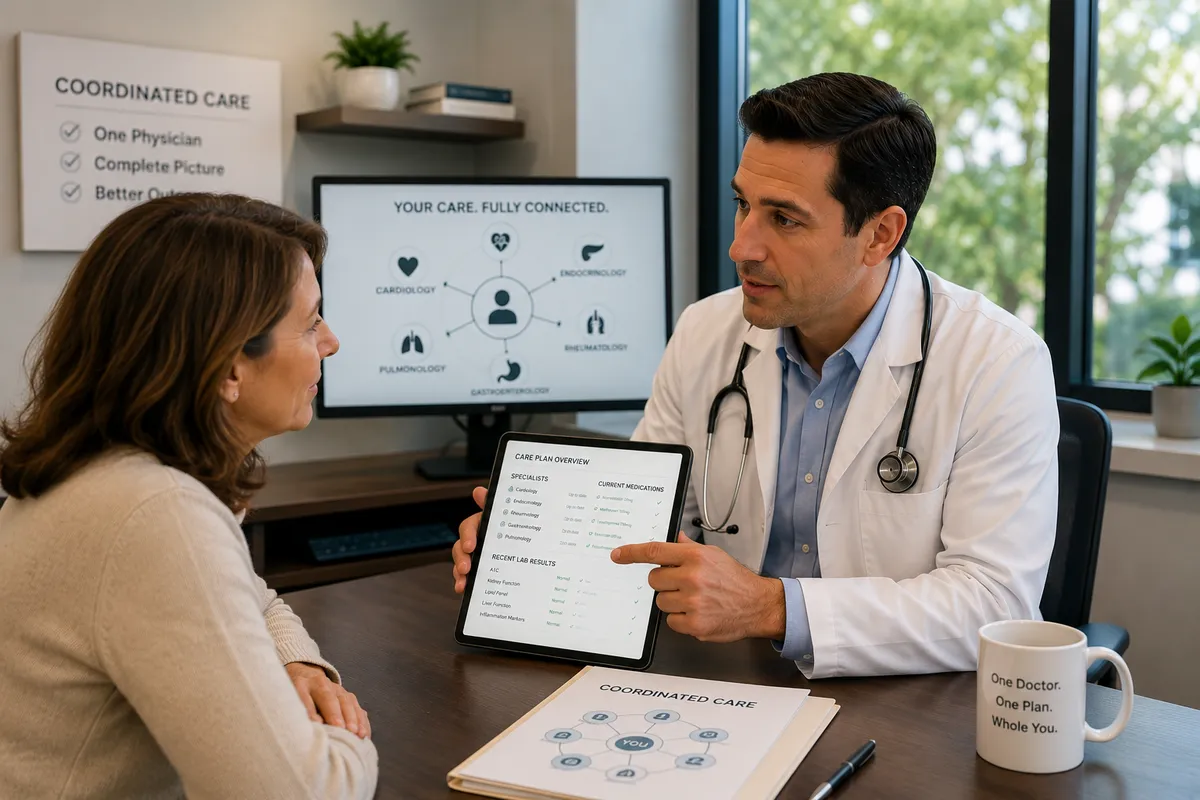
Five Specialists, No Coordinator. Why Having the Best Doctors in Los Angeles Is Not the Same as Having a Plan
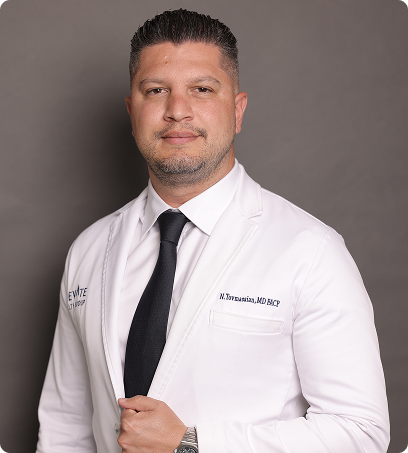
Los Angeles has extraordinary specialists. World-class cardiologists, endocrinologists, rheumatologists, and gastroenterologists, with patients travelling here from other states to reach them. And yet some of the most medically complex patients in this city describe their healthcare in the same frustrated terms: nobody is talking to each other, they are the ones carrying information between appointments, and nothing quite adds up into a coherent plan.
This is not a physician quality problem. It is a structural one. The solution is not more specialists. It is a physician who practices internal medicine the way it was designed to be practiced, as the connective tissue between every other layer of a patient's care.
At Elevate Health Group, our internal medicine physicians do what complex patients actually need: keep the entire field in view.
What Coordinated Care Actually Means
The term gets used loosely, so let us be specific. Coordinated care is not a care manager sending appointment reminders, and it is not a patient portal where records sit in one place. Those are administrative tools.
Clinical care coordination means:
- Your physician receives specialist notes, reviews them rather than filing them, and updates your care plan when they contain something that changes the picture
- When one specialist changes a medication that interacts with something another prescribed, your physician catches the conflict before you do
- When you need a new referral, your physician prepares the specialist with your relevant history, so you are not spending the first part of the appointment re-explaining the last five years
- When something changes in your health, one physician understands what it means across all your conditions at once, rather than one slice of it
This is internal medicine done well. It is the difference between a specialist who manages a condition and a physician who manages a patient.
The evidence supports it. A systematic review published in the American Journal of Managed Care found continuity of outpatient care associated with lower rates of avoidable hospitalization, and research in PLOS One on older adults with complex care needs found continuity of primary care associated with reduced use of hospital-based care.
How Fragmented Specialist Care Fails Patients
Medication conflicts nobody caught
A cardiologist prescribes a beta-blocker. A rheumatologist adds an NSAID for joint inflammation. An endocrinologist adjusts diabetes medication. None of these physicians is looking at the same chart at the same time, and the prescriptions may come from different pharmacies. An interaction between them may not surface until a side effect does.
A physician reviewing one unified medication list, which is what our internists do, can catch these conflicts before they become a clinical event.
Referrals that go nowhere
"Follow up with your PCP" is one of the most common lines in specialist discharge notes. Without an established primary care relationship, that recommendation has nowhere to land. The patient leaves with advice that never gets integrated into a plan.
Labs that do not connect
When blood work is ordered by your cardiologist and run by a hospital lab, and your endocrinologist ordered a similar panel last month through a different lab, nobody is looking at the trend. A gradual change in kidney function over two years is exactly the kind of thing that gets missed when results live in separate systems.
Our on-site laboratory runs tests that your primary care physician reviews directly. Your labs are not floating in a separate portal. They are in your chart, in front of the physician who knows what they mean in context. We also provide EKG and ultrasound testing in house, so the most commonly needed diagnostics do not require a separate trip.
How EHG Manages Specialist Relationships
Before the referral. When a referral to a cardiologist, pulmonologist, or neurologist is clinically indicated, your EHG physician prepares a summary of your relevant history, current medications, past workup, the clinical reasoning behind the referral, and the specific questions we need answered. Context, not just a form.
After the specialist visit. We follow up on referrals, and request the specialist's note if it does not arrive. When it does, your EHG physician reviews it in the context of everything else we know about you. If a recommendation conflicts with another part of your care, we work to resolve that before it reaches you as a contradictory set of instructions.
At every visit. Your medication list is reconciled rather than copied forward from the last note. For patients on several medications, this is one of the highest-value things a primary care physician can do.
For patients managing diabetes, hypertension, or high cholesterol alongside specialist-managed conditions, EHG can often become the site of management for all three, reducing the number of separate physician relationships you maintain.
An Illustrative Example
The following is a hypothetical scenario, not a real patient.
Imagine an adult in his early sixties with Type 2 diabetes managed by an endocrinologist, atrial fibrillation managed by a cardiologist, and early-stage chronic kidney disease managed by a nephrologist. Three excellent specialists. None of them is reviewing his care as a whole.
The nephrologist wants blood pressure lowered. The cardiologist has him on a rate-controlling medication with its own dosing considerations. The endocrinologist recently changed his diabetes medication, and some diabetes drug classes require dose adjustment as kidney function declines. The information exists in three separate records.
An internist managing this patient from a single unified chart can see all three intersections at one visit. Not because the specialists failed, but because this is what a coordinating physician is for. Meet our physicians.
For how annual preventive visits create the baseline for this kind of coordination, see what happens during an annual physical in Los Angeles.
What to Expect at a New Patient Appointment
Your first visit at EHG is a full intake. We want to understand your clinical history, your current specialist relationships, your medication list, and where you feel the gaps in your care. From there, your physician builds a framework that clarifies what we manage here, what stays with your specialists, and how those two layers communicate.
If you are weighing whether high-touch primary care is worth it, see best concierge medicine doctors in Los Angeles.
Frequently Asked Questions
What does an internal medicine physician do that a general practitioner does not?
Internal medicine physicians complete a three-year residency focused on adult disease across multiple organ systems, whereas family medicine residencies also cover pediatrics and obstetrics. An internist is trained to manage medically complex adults with overlapping conditions, medication interactions, and ambiguous presentations. Our internists work with panel sizes that leave room for genuine coordination.
Can EHG take over management of conditions I currently see a specialist for?
Often, yes. Conditions such as hypertension, Type 2 diabetes, high cholesterol, and hypothyroidism can frequently be managed long term by an experienced internal medicine physician. Whether that is right for you is a clinical decision your physician makes with you, based on what still needs ongoing subspecialty involvement.
How do you get notes from my current specialists?
With your signed authorization, we request records directly from your specialist practices. We also ask you to bring any recent discharge summaries, lab results, or specialist letters you have. Your physician then reviews and integrates them into your record.
Is care coordination billed separately?
Reviewing specialist notes, reconciling medications, and managing referrals are part of how we practice, and we bill your insurance for the physician visit. If any coordination service would ever be billed separately, our office will tell you before it happens. Contact us with any billing question and we will confirm specifics for your plan.
Do I need to stop seeing my specialists to become an EHG patient?
No. Many EHG patients keep their specialist relationships. The goal is not to replace your specialists, it is to make sure someone with full clinical context is integrating what they recommend into one plan. Some patients find over time that fewer specialist visits are needed, but that is a clinical decision, not an automatic one.
YOU MIGHT ALSO ENJOY...

You Should Not Have to Wait Until Tomorrow to Know What You Have or to Start Treating It
Walk in with symptoms, leave with a diagnosis and a prescription. Rapid strep, flu, and COVID testing with same-visit treatment in Glendale and Burbank.

If You Have Had Three Sinus Infections This Year, You Do Not Have Bad Luck. You Have a Root Cause That Nobody Has Addressed Yet.
Repeated sinus infections are a pattern, not bad luck. How Elevate Health Group looks for the underlying driver in Glendale, Burbank and La Cañada.