


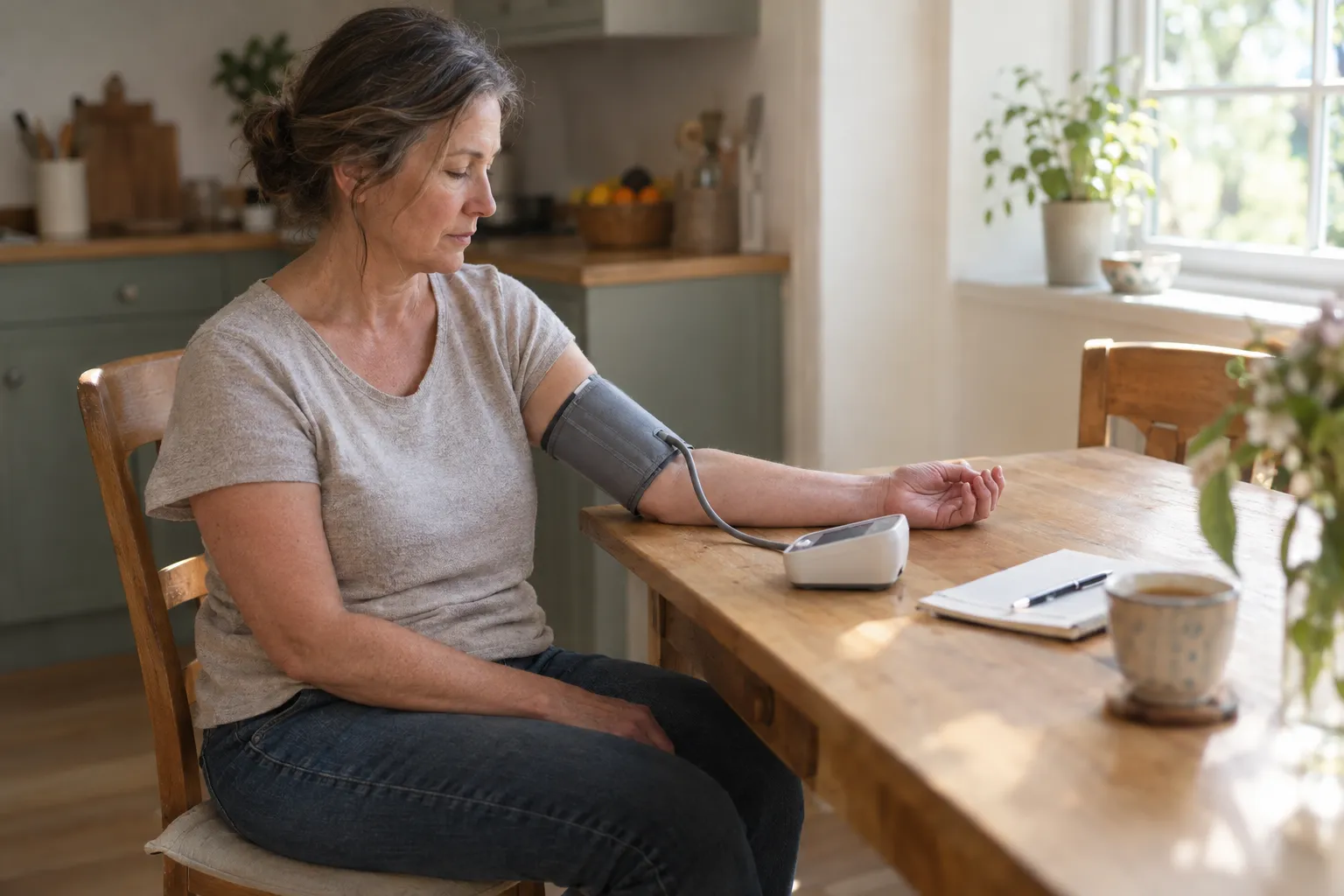
Why Your Blood Pressure Reads High at the Doctor and Normal at Home

It is one of the most common things people raise in an exam room: the reading on the cuff is high, and they are certain it is not like that at home. They are often right. They are also sometimes wrong in the other direction, with readings that look fine in the office and are not fine the rest of the time.
Both situations have names, both are common, and distinguishing between them changes whether someone needs treatment. The 2025 American Heart Association and American College of Cardiology guideline put measurement outside the office at the center of how high blood pressure is diagnosed and managed, which makes what you do at home part of the diagnosis rather than a curiosity.
Two patterns, opposite problems
White coat hypertension is a blood pressure that is elevated in a medical setting and normal outside it. The usual cause is simply the setting: the appointment, the rush to get there, the waiting, and for some people the reading itself.
Masked hypertension is the reverse, and it is the dangerous one. Blood pressure looks acceptable in the office and runs high during ordinary life, often because of work stress, sleep, alcohol or physical inactivity that the office visit never sees. Someone with masked hypertension is reassured at every appointment while the damage continues, which is why the guideline specifically emphasizes detecting it to avoid undertreatment.
There is also a white coat effect in people already diagnosed and treated: office readings run higher than their true average, which can lead to medication being increased when it did not need to be. The guideline is explicit that the white coat effect should be excluded before intensifying treatment, particularly where blood pressure appears resistant to it.
You cannot tell which pattern you have from office readings alone. That is the whole point.
What counts as high
Hypertension is defined as 130/80 mm Hg or above, with stage 2 at 140/90 or above. The treatment goal is below 130/80, and the 2025 guideline encourages aiming for below 120/80 for most adults, with exceptions including pregnancy, limited life expectancy and people in institutional care.
Whether medication is recommended at a given number depends on your overall cardiovascular risk rather than the reading alone. For someone with previous cardiovascular disease, diabetes or kidney disease, or a ten-year risk of 7.5 percent or higher, medication is recommended at 130/80. Below that risk level, the first step is three to six months of lifestyle change, with medication considered if blood pressure stays at or above 130/80.
The guideline also replaced the old risk calculator with a newer model called PREVENT, which estimates both ten-year and thirty-year risk, includes heart failure as an outcome, and factors in kidney function and other variables the previous equations left out. In practice that means the risk number your physician quotes may differ from one you were given a few years ago, and that is the reason. Our hypertension and high cholesterol services both use that framework.
How to measure at home so the numbers mean something
Home readings are only useful if they are taken properly, and most people are taught none of this. The technique matters as much as the device.
- Use an upper arm cuff, and check the cuff size fits your arm. A cuff that is too small reads high. Wrist and finger devices are less reliable.
- Empty your bladder first, then sit quietly for five minutes before the first reading. No coffee, no cigarettes and no exercise in the half hour before.
- Sit with your back supported and your feet flat on the floor. Do not cross your legs.
- Rest your arm on a table so the cuff is level with your heart. An unsupported arm, or one held too low, changes the number.
- Put the cuff on bare skin, not over a sleeve.
- Do not talk during the reading, and do not look at your phone.
- Take two readings a minute apart and record both. Take them twice a day, morning and evening, for seven days, and discard the first day entirely.
- Record every reading, including the ones you do not like. Deleting the high ones is the most common way home monitoring gets ruined, and it produces a diagnosis based on your editing rather than your blood pressure.
Bring the full set to your appointment, or bring the device itself so its accuracy can be checked against the office cuff. A week of properly taken readings is worth more to your physician than any single measurement taken in the room.
One thing not to use
The 2025 guideline states that cuffless blood pressure devices are not recommended for diagnosing or managing high blood pressure. That includes smartwatches and rings that estimate blood pressure without inflating a cuff around your arm.
They may be interesting, and the technology will likely improve, but at present the numbers they produce are not accurate enough to make a diagnosis or adjust a medication. If you are tracking your blood pressure for a medical reason, use a validated upper arm cuff.
What happens after you bring the readings in
If home readings are consistently normal and office readings are not, that is white coat hypertension, and it usually means monitoring rather than medication, because the risk sits between normal blood pressure and sustained hypertension rather than at either end. If home readings are high, that is a diagnosis, and the conversation moves to what to do about it.
If the picture is unclear, a 24-hour ambulatory monitor is the next step, since it captures readings while you sleep, which neither you nor an office visit can do. Either way the workup includes bloodwork through our on-site laboratory to check kidney function and look for a treatable cause, and often an EKG to see whether the heart shows strain from pressure that has been high for a while. Our guide to bloodwork, EKG and ultrasound covers what those tests involve.
This is ordinary internal medicine and it is the kind of problem that is far easier to manage with one practice tracking the trend over years. If you have never had a baseline, what happens at an annual checkup explains where blood pressure fits alongside everything else, and an adult physical is where to start.
Service Area
Blood pressure evaluation and management are available at our Glendale, Burbank and La Cañada offices, serving patients across Los Angeles County including Pasadena, Toluca Lake and the surrounding foothill communities.
Frequently Asked Questions
Need Help? Find Answers Here
Bring a week of readings to your next visit
If office readings have been high and you suspect they are not the whole picture, the useful next step is seven days of properly taken home readings and an appointment to go through them. Contact our office to book in Glendale, Burbank or La Cañada.
This article is general health information, not medical advice, and reading it does not create a physician-patient relationship. Blood pressure targets and treatment decisions are individual and depend on your full medical history. Do not start, change or stop any medication without speaking to a qualified clinician.
YOU MIGHT ALSO ENJOY...
Galleri Test Cost: What You Pay, What's Included and What It Is Not
What the Galleri multi-cancer blood test costs in Glendale, why insurance does not cover it yet, and the follow-up costs the sticker price leaves out.

Hormone Pellet Therapy Cost: What Drives the Price and What to Ask
Why no clinic can quote one number for hormone pellet therapy, what insurance will and will not cover, and the questions to ask before you pay.
Our Locations:
214 N Central Ave, Glendale, CA 912031407 Foothill Blvd, La Canada, CA 910113808 W. Riverside Dr, Ste 120, Burbank, CA 91505Hours of Operation:
Mon - Fri: 8:00 AM to 12:00 PM, 1:00 PM to 5:00 PM
Sat - Sun: Closed
© 2026 Elevate Health Group. All rights reserved.
 Designed & Developed by The Gud Agency