


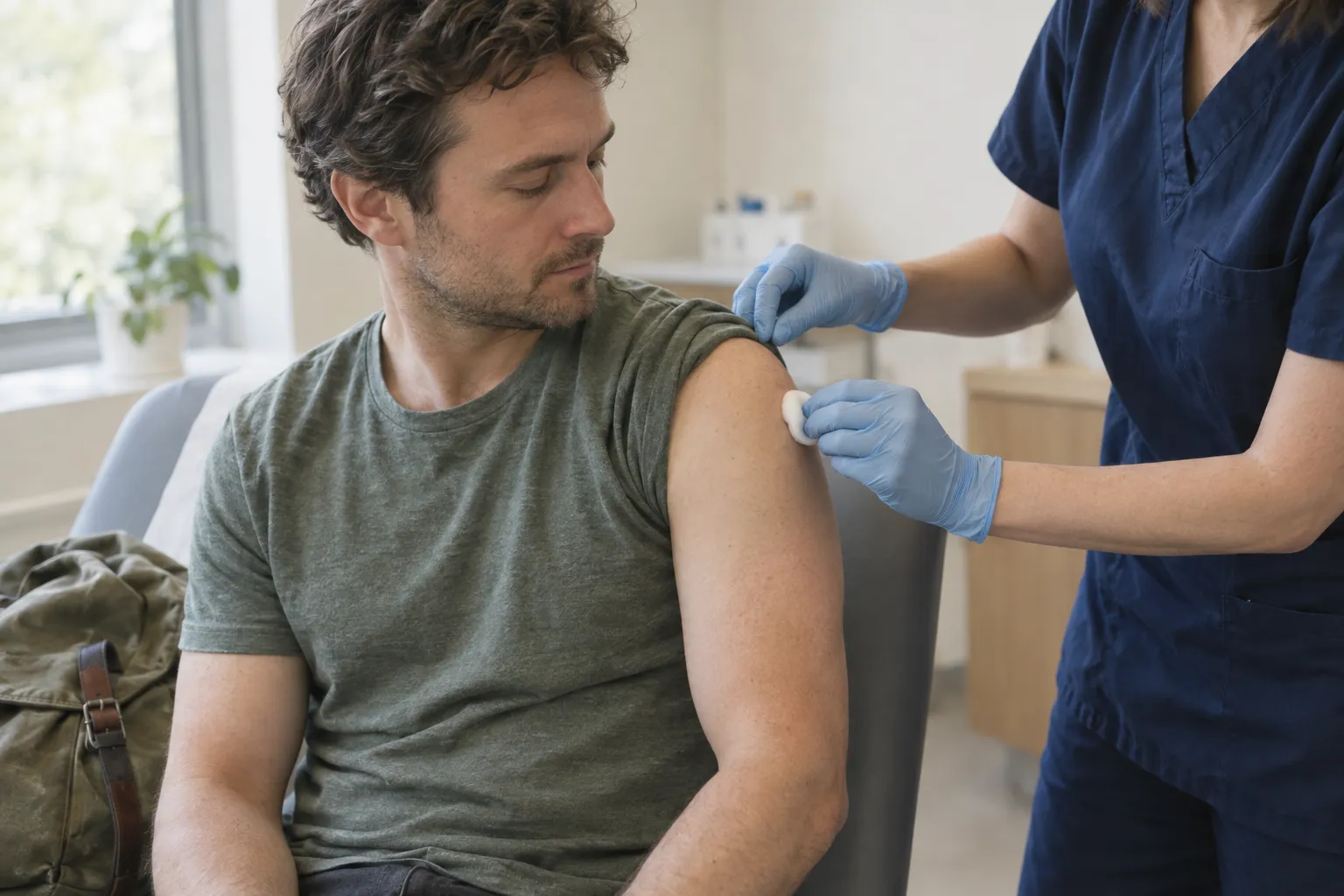
Travel Vaccines in Los Angeles: What You Need and How Far Ahead to Book
The most common mistake in travel health is not choosing the wrong vaccine. It is booking too late. Several travel vaccines need more than one dose spread over weeks, and some need time after the final dose before they protect you. A visit ten days before a flight limits your options to whatever can be given in a single shot.
CDC advises making a travel health appointment at least four to six weeks before you leave. This article covers what that visit actually involves, which vaccines are worth asking about for which trips, the one vaccine you may not be able to get at an ordinary clinic, and what to do if you have left it late anyway.
Why four to six weeks
Three reasons, and they compound.
- Multi-dose schedules. Several travel vaccines are given as a series rather than a single injection, and the doses are spaced out by design. Starting late means arriving partially protected or not protected at all.
- Time to take effect. Your immune system needs time after the last dose. The shot is not a switch.
- Supply and documentation. Some travel vaccines are not stocked the way a flu shot is, and some destinations require a certificate that has to be issued correctly. Both take lead time.
There is also a practical reason: if a vaccine makes you feel rough for a day, you would rather that happened at home than in an airport.
What a travel consultation covers
A travel medicine consultation is a risk assessment, not a vaccine menu. Two people flying to the same country can need different things, because risk depends on more than the destination:
- Where exactly you are going, since risk often differs sharply between a capital city and a rural region of the same country.
- How long you will be there, and whether you are in hotels or staying with family.
- What you will be doing. Trekking, freshwater swimming, working with animals, visiting farms and long bus journeys all change the picture.
- The season you are traveling in, which drives mosquito-borne and respiratory risk.
- Your own health: your medications, whether you are pregnant, and whether your immune system is suppressed, all of which affect which vaccines are appropriate.
- What you have had before, which is why your vaccination records matter more than your memory of them.
The visit should also cover things that are not vaccines at all and that cause more trouble than most vaccine-preventable disease: food and water precautions, mosquito-bite prevention, malaria prevention if your destination needs it, what to do about travelers’ diarrhea, altitude, and how to get medical care abroad if you need it.
Which vaccines come up
CDC lists the following as vaccines you may need, either as a first course or as a booster, depending on destination and history. This is a list to discuss, not a list to request.
| Category | Vaccines |
|---|---|
| Routine, brought up to date | MMR, Tdap, polio, chickenpox, pneumococcal, shingles, influenza, COVID-19 |
| Food and water exposure | Hepatitis A, typhoid, cholera |
| Blood, bodily fluid or medical exposure | Hepatitis B |
| Animal and insect exposure | Rabies, Japanese encephalitis, tick-borne encephalitis, chikungunya |
| Crowding and region specific | Meningococcal, mpox |
| Required for entry in some countries | Yellow fever, and in some cases meningococcal or polio documentation |
The routine row is the one travelers skip and the one that matters most. Measles outbreaks happen in destinations people think of as low risk, and MMR is the single most valuable thing many travelers can update. Our vaccines page covers what we stock, and the flu shot is worth timing around your trip if you are traveling into another hemisphere’s winter.
Yellow fever is the exception, so ask first
Yellow fever vaccine can only be given at a center authorized to administer it, and it is the one vaccine where that restriction applies. Some countries require proof of yellow fever vaccination for entry, which makes the certificate a travel document rather than just a health record.
If your destination recommends or requires it, ask when you book whether the clinic is an authorized yellow fever center. CDC maintains a searchable list of authorized centers, and it is worth checking before you drive anywhere. Any other pre-travel care can still be handled at your own practice.
If you have left it late
Go anyway. A late appointment is worth far more than no appointment, and this is where a consultation earns its keep: a clinician can tell you which protection is still achievable in the time you have, what is not, and what to do differently on the trip to compensate.
- Some vaccines can be given on an accelerated schedule where one exists, though not all can.
- Malaria prevention is medication rather than a vaccine, and can usually be started close to departure.
- Prescriptions worth discussing even at short notice include something for travelers’ diarrhea and, for high-altitude trips, altitude sickness.
- Behavioral precautions do most of the work on a short lead time: what you eat and drink, insect-bite prevention, and avoiding animal contact.
What a clinician should not do is give you every vaccine at once to make up for lost weeks without explaining whether it will actually protect you in time.
What to bring
- Your full itinerary, with regions and dates, not just the country.
- Your vaccination records, including childhood records if you have them.
- A list of your current medications and doses.
- Your insurance details, plus any travel insurance policy, since pre-travel visits and vaccines are often not covered in the way routine care is.
If your records are incomplete, bloodwork through our on-site laboratory can sometimes establish whether you are already immune to something, which avoids repeating a vaccine unnecessarily.
Service Area
Travel consultations are available at our Glendale, Burbank and La Cañada offices, serving travelers across Los Angeles County including Pasadena, Toluca Lake and the surrounding foothill communities.
Frequently Asked Questions
Need Help? Find Answers Here
Book before you book the flights
Ideally the travel appointment goes in the diary when the trip does. Contact our office to arrange a consultation in Glendale, Burbank or La Cañada, and bring the itinerary. If your trip is sooner than four weeks away, call anyway, since something useful is almost always still possible. Keeping preventive care current year-round also means fewer gaps to fill in a hurry.
This article is general health information, not medical advice, and reading it does not create a physician-patient relationship. Vaccine recommendations and entry requirements change and vary by destination, region and season. Check CDC Travelers’ Health for your specific destination and confirm current requirements with the relevant embassy or consulate before traveling.
YOU MIGHT ALSO ENJOY...

Semaglutide vs Tirzepatide: How They Differ and What the Trials Found
A physician-reviewed look at semaglutide and tirzepatide: how each one works, what the head-to-head trial measured, and what both labels warn about.
Same-Day Doctor Visits in La Cañada: Hours and Conditions Treated
Same-day appointments at our La Cañada office: hours, what gets treated, what is tested on site, and when the emergency room is the right call instead.
Our Locations:
214 N Central Ave, Glendale, CA 912031407 Foothill Blvd, La Canada, CA 910113808 W. Riverside Dr, Ste 120, Burbank, CA 91505Hours of Operation:
Mon - Fri: 8:00 AM to 12:00 PM, 1:00 PM to 5:00 PM
Sat - Sun: Closed
© 2026 Elevate Health Group. All rights reserved.
 Designed & Developed by The Gud Agency